Pages

I have sent out a Form for my classmates to finish so I can understand people’s opinions on music and what they look for in a soundtrack. Knowing what people would like to see is key in creating a soundtrack will give me an idea on how to produce the tracks and give me inspiration for certain sounds.
After sending out the form to the class, five people responded. Their answers have been noted and will be taken into consideration when producing the music. The question for what genre of music should I use to create the soundtrack, the overwhelming answer is atmospheric. Which is perfect since I had indeed to make an atmospheric soundtrack. However the soundtrack will not be purely atmospheric, I intended to blend many genres together, while having the atmospheric sounds as the foundation of the soundtrack. Therefore I can incorporate the less picked options of the form into the project. Incorporating all these different sounds into an EP will surely be difficult however the secondary research will be utilised on how to create the sounds of certain genres that I struggle with.
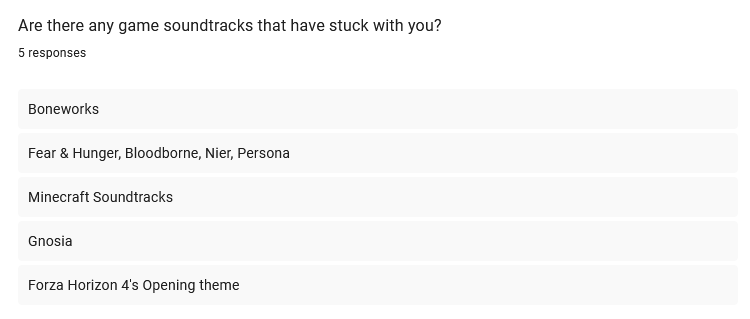
Knowing what soundtracks have stuck with people is crucial in my research since it gives me clear examples of soundtracks that have left a clear impression on people. Ensuring that a soundtrack is memorable is one of the key factors in ensuring a successful OST. This isn’t as simple as making a song that sounds good, but making a song that makes people feel something. Ensuring that the context of the game has been taken into account when producing the OST is crucial in making the player feel something. However the opposite can be true, but is quite difficult to pull off without seeming completely out of place.
"Blight: The atmosphere is done really well, giving the song a lot of depth. I appreciate the consistent panning of the drums because it adds variation to the song. The descending piano every so often is a really nice touch and helps emphasise sections of the song, the same goes for the ascending sound that plays. I would’ve liked to see more low end in the song such as some kind of bass to help round out the song a bit more.
Lychee: I was extremely surprised going into this song, immediately it was very different to Blight, but not in a bad way. The piano melody is really nice and fits the song well, additionally the instruments in the background perfectly compliment the piano. It feels extremely melancholic, and despite there being quite a lot of instruments in the song, it still feels ambient, while giving room for more personality.
Sanctuary: This song has a similar feeling to Lychee, like sorrow but with hope. The violin in the background of the song helps carry the song quite a lot, additionally the rising sound at the end of each bar helps emphasise the song's rhythm. I do think that some of the introductions of the instruments could’ve been shifted to be later to prevent the song from becoming too repetitive. I do appreciate the ending finishing with only the piano, it really helps it feel like a conclusion, you could add some reverb or delay on the final note to really help nail the ending of the song.
Starting Again: The instrument at the beginning of the song alongside the sample in the background helped the song feel extremely airy, and almost like it was being played in an extremely large room. Despite this song having a lack of low end, I feel as if it helps in this song's case, as it emphasizes that ethereal tone that I’m assuming you’re going for. The only problem with this song is that I believe it becomes too repetitive over time, although the switch at 1:40 was definitely helpful to sort of refresh the track. A lot of the chords used on the pad in the background feel very dissonant, helping that ethereal but sorrowful feeling.
Transient Microcosm: This song immediately feels the most Karbonic of them all, I can’t exactly place why but I believe it’s due to the main lead of the song, It sounds almost exactly like something I’ve heard Karbonic use before, furthermore the drums feel much more similar to the way Karbonic’s drums do. Overall this song sounds the most joyful of them all, almost lively, like I’m in a village of sorts. It makes me think of the Thraits from Psychopomp quite a lot, although I think it overall reminds me the most of Dreamwild.""
For context and pretense, I have no clue what goes into actual music production nor do I know the technical terms for each specific thing so I will be purely looking at each song objectively and what I like / dislike about each one and explaining why I like them.
"Blight - For Blight, I really like the backing noises that sound similar to talking / robotic jargon, I think it adds a nice layer of depth to the song itself. As well as this, the droning sound adds to the atmosphere and is executed extremely well. Around 1:30 into the song there is a series of descending notes that I quite enjoy as it adds a melody that is separate to the ambience itself.
Starting Again - Going into this song I immediately notice a sample of voices from somewhere and I quite enjoy how it introduces the structure of notes that follow. The rising sound evoques a feeling of hope within me as well as a bittersweet feeling of sorts. As this song is purely ambient in nature I quite like it. It hits close to home as it reminds me of a toy that I owned when I was younger that had a similar melody to it and hits me close with the childhood nostalgia. About 2 minutes in the tone takes a slight shift into a zanier / moodier sort of vibe which I quite enjoy. It keeps the song from feeling too repetitive in nature.
It then transitions (2:30) into a calmer bell / glockenspiel sound with a cascading series of notes and it introduces the voice samples again which I quite enjoy. It reminds me of LoFi music and how they sample media in a calming way. I can definitely see this song being used in an ambient EP or a game.
Sanctuary - Immediately going into this song I noticed the series of notes with bells atop of them. The song itself at the beginning feels very festive and christmassy, possibly not the intention. However, that is the feeling that I get when listening to the beginning of Sanctuary. Thereafter, I also feel the bittersweet feeling as it evoques a pretty somber feeling within me mixed with a semblance of hope and uplift. I quite enjoy the melody as well. I can’t quite place my finger on why I enjoy it so much. I think it’s mainly down to the instruments and VSTs used.
The piano that follows at the end is extremely well done and the note structure is something that I immediately noticed when the song transitioned to this part. I think the melody itself is extremely nice and deserving of praise.
Lychee - Lychee at the beginning feels very dissimilar to the rest of the EP. However, that doesn’t impact my view of it negatively as I quite enjoy the tonal shift from all of the other songs to Lychee. I think the piano combined with the other instruments blend extremely well and feels well-structured which is quite pleasing to the ears as you can definitely feel each instrument working in harmony to compliment the melody being given. Jac clearly exhibits an understanding of making a great melody. Whilst it is different, the song itself is STILL ambient in nature which I quite enjoy. I can definitely see myself listening to it in my own time whilst travelling (this can be said for the entire EP but this song in particular caught my attention).
And finally we are led to -
Transient Microcosm - Finally, going into this song, I quite enjoy the drums used as well as the melody itself. From the beginning, it reminds me of the main song from “Don’t press the button” and I quite enjoy the cascading series of notes thereafter that follow. I also loved the ambient feeling of the song as it felt quite airy.""
The peer review was incredibly helpful through the production of the EP. I would send Faith and George songs after I was done producing and asking for their feedback and for them to note their thoughts. Their opinions were taken into heavy consideration during the production process and gave me an insight on what others wanted to hear. Their feedback will help me further my production skills in the future. Notes from faith especially, since she produces music. Having a like-minded person review my music is really helpful in developing my skills. If I were to ask for peer feedback in the future, I would ensure to consult the music department, since people with musical experience can offer more valuable feedback.
When creating ambient music it's important to keep spatialization in mind. It essentially means placement and movement of sounds across the stereo field. A fundamental technique of spatialization is panning, panning can create the perception of sonic depth perception. This adds a layer of depth to the song. Panning high frequencies left to right with delay or reverb can be utilised to achieve sonic depth perception. (Sonic depth essentially means sound perception, being able to differentiate distance or speed with sound alone. Most commonly an example of this is the doppler effect). When creating ambient music it's important to layer instruments/sound effects. Producers give their tracks atmosphere by layering many textures. Using synthesisers and utilising oscillators (which Serum one of the main synthesizer plugins I will be using has built in oscillators) will allow me to create diverse pads and sounds.
Since karbonic is one of my major inspirations for starting this project I found it necessary to research his music and study different projects of his. One noticeable “quirk” of Karbonics music within the game Dreamwild is that almost all of the instruments are BitCrushed (sometimes the drums and strings aren’t) notable examples of BitCrushing within the dreamworld ost are songs such as “Slow movements In A Lilac Way” and “Get Dreamin’”. Bitcrushing the audio buses containing instruments give the songs a vintage vibe to them, making them sound like they are from an old game. This technique works for games such as dreamworld due to the weirdcore and absurdist aesthetics, it gives areas a nostalgic feeling.
Karbonic’s music also utilises a wide range of instruments, notable instruments that appear in a wide range of his work are synthesizer pads to achieve an ambient sound. When making ambient music it's important to have layers of pads and extended chords. Extended chords are ever present in ambient music and Karbonic's own work. Therefore using them in my own production is key in ensuring an ambient/textured sound.
Above all else, a soundtrack’s role in the video game is to build atmosphere. However, a key role of soundtracks is ensuring that they make the player feel something, whether that be joy, sadness, or dread. The key to making a memorable soundtrack is to make one that makes the player feel these feelings. Building an atmosphere can lead to making the player feel emotions, therefore its key to understand the context to which you are creating the specific piece for.
For example, walking into a boss area and being faced against a fierce foe, having to fight with everything that you have. Having moments of near defeat, and actually managing to pull through after using all of your might and accumulated skill. And softly in the background hearing a choir sing as you are fighting for your life. The music is amplified due to adrenaline. Hearing the music of the boss slowly fade out as you stand victorious. These moments in video games make the player feel euphoria. The video game that does this the best personally is Dark Souls and the example itself is based on a fight within the game (Dragonslayer Ornstein and Executioner Smough. Having to fight enemies that completely out skill you, and somehow emerging victorious makes playing the game entirely worth it. And the supporting tracks in the fights build atmosphere and cut through the tension. Having complicated orchestral pieces playing while fighting an enemy within a palace (pertains to the previous dark souls example) truly makes the player feel like they are in the world.
Video of the Boss Battle <--
When creating ambient music it's important to keep spatialization in mind. It essentially means placement and movement of sounds across the stereo field. A fundamental technique of spatialization is panning, panning can create the perception of sonic depth perception. This adds a layer of depth to the song. Panning high frequencies left to right with delay or reverb can be utilised to achieve sonic depth perception. (Sonic depth essentially means sound perception, being able to differentiate distance or speed with sound alone. Most commonly an example of this is the doppler effect). When creating ambient music it's important to layer instruments/sound effects. Producers give their tracks atmosphere by layering many textures. Using synthesisers and utilising oscillators (which Serum one of the main synthesizer plugins I will be using has built in oscillators) will allow me to create diverse pads and sounds.
I would consider myself rather proficient in music theory, I understand the basic concepts and many harder ones which help me with producing music. Therefore for my research I tried to solidify my knowledge on concepts that I didn’t fully understand.
A concept that I’ve always somewhat struggled to understand is time signatures. When making music time signatures define the amount and type of notes that each measure contains. The explanation of it is rather simple, but implementing time signatures other than the basic 4/4 has always been a struggle of mine. 4/4 (four to the floor) is a time signature that almost every modern pop song uses, and is what most DAW’s default too. (Wikipedia, 2022)
Example of the 6/8 time signature.
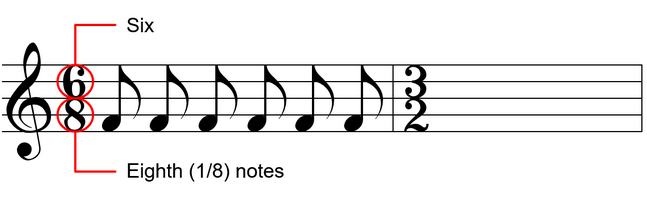
Simple meters are those whose top number is 2, 3, or 4, occasionally described as duple meter, triple meter, and quadruple meter. In compound metres, the note values specified by the bottom number are grouped into threes, and the upper number is a multiple of 3 such as 6, 9, or 12. The lower number is most commonly an 8.(Wikipedia, 2022)
Depending on the tempo of the music, a beat may correspond to the note value specified by the time signature, or to a grouping of such note values. Most commonly, in simple time signatures, the beat is the same as the note value of the signature. (Wikipedia, 2022)
Another musical concept that I know but haven't mastered is the circle of fifths.
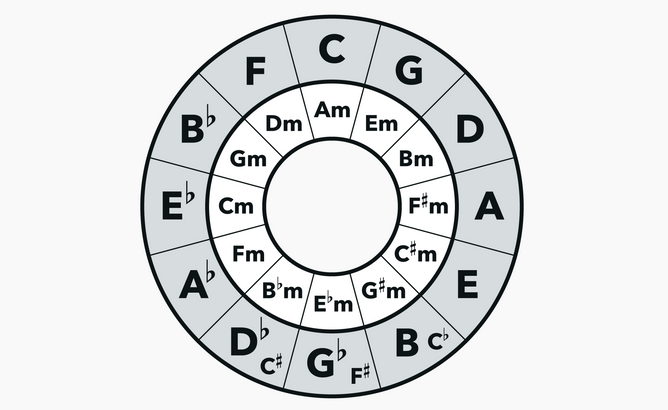
The circle of fifths developed in the late 1600s and early 1700s to theorize the modulation of the Baroque era. The first circle of fifths diagram appears in the Grammatika of the composer and theorist Mykola Pavlovych Dyletsky, who intended to present music theory as a tool for composition. (Wikipedia, 2020)
The circle of fifths is a visual diagram showing the relationship between different keys. If you go clockwise the pitches ascend by fifths. The circle of fifths is commonly used in creating chord progressions. Note that the circle of fifths isn't chord substitution, it shows the relationships between chords that make a chord progression. Referring to the Circle of Fifths can help you discover interesting chord progressions, particularly when you’re stuck for what the next chord wants to be. (Wikipedia, 2020)
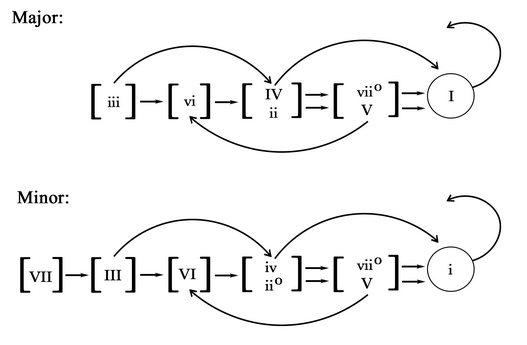
Harmony in music basically means combining different sounds in order to create new sounds. It's an auditory occurrence where sounds that are perceived as separate tones occur at the same time. Harmony is a mixture of sounds that form a texture. Harmony is not only sounds from stacking notes into chords, it can do more. Harmony is both vertical and horizontal. (Wikipedia Contributors, 2019)
The Diagram below is a very good example of Major Harmonization and Minor Harmonization.
For this project I intend on using plugins that I have barely/never used before. This will expand my knowledge on how to use these presets and broaden my choices when producing music in the future.
On the website Digitalis is described as a “multi-effect digital degradation and glitch tool”. It has many unique tools for manipulating sound.
Digitalis Website <--This list was taken directly from the Digitalis page on the Aberrant DSP website:
Spectral filtering PaintBox, allowing you to filter your audio with custom patterns
Pitch section including pitch shifting, formant shifting, and pitch quantization
Telecommunications section for lossy audio effects
Decimate section for flexible downsampling effects
Dynamic bitcrushing section with multiple modes for a wide range of digital fizz and grit
Bitrot section, emulating data loss and corruption on old digital media
Highly adjustable Repeater section for tempo-synced or free-floating retrigger and beat-repeat effects
Pitch Shift and Bend controls for modulating repeats
Rhythm Glitch and Pitch Glitch controls, adding a layer of chaos and complexity to repeater patterns
Customizable window order, allowing you to change Digitalis’s signal flow
16-step, tempo-synced sequencer with 4 slots for effects, opening up endless possibilities for custom modulations and rhythmic variations
Advanced AI assistant Jon to guide you through all that Digitalis has to offer
Custom preset system with 98 factory presets illustrating Digitalis’s vast arsenal of effects
Fruity balance is a very simple plugin. Attaching it to the mixer rack allows you to control the volume of a particular sound. It’s great for real time automation and allows you to pan the sound with the Balance knob. (Image-line.com, 2026)
Fruity Balance website <--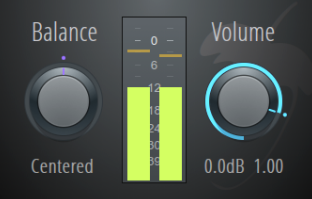
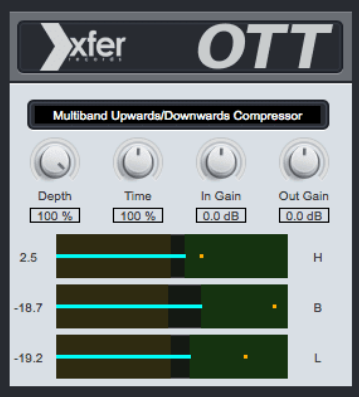
OTT is a multiband upwards/downwards compressor. It's mainly used in genres such as electronic music and dubstep. A compressor helps you control the overall dynamic range of the song by maintaining consistent and balanced audio levels, ensuring that there isn’t any peaking. I personally feel that it's the best free compressor on the market. It was also made by xfer which is the company that made Serum. (Splice, n.d.)
Since karbonic is one of my major inspirations for starting this project I found it necessary to research his music and study different projects of his. One noticeable “quirk” of Karbonics music within the game Dreamwild is that almost all of the instruments are BitCrushed (sometimes the drums and strings aren’t) notable examples of BitCrushing within the dreamworld ost are songs such as “Slow movements In A Lilac Way” and “Get Dreamin’”. Bitcrushing the audio buses containing instruments give the songs a vintage vibe to them, making them sound like they are from an old game. This technique works for games such as dreamworld due to the weirdcore and absurdist aesthetics, it gives areas a nostalgic feeling.
Karbonic’s music also utilises a wide range of instruments, notable instruments that appear in a wide range of his work are synthesizer pads to achieve an ambient sound. When making ambient music it's important to have layers of pads and extended chords. Extended chords are ever present in ambient music and Karbonic's own work. Therefore using them in my own production is key in ensuring an ambient/textured sound.
Here's a good video explaning the process:
Side Chaining Video <--
At its most basic an audio visualizer is graphics that reacts to sound. The program that I am going to use for the creation of the audio visualiser is Touch Designer. TouchDesigner is a visual development platform that allows you to create “omnimedial realtime projects” and “novel user experiences”. It's great for various different projects and allows you to input your own code with Python. For this project I intend on using visual coding.
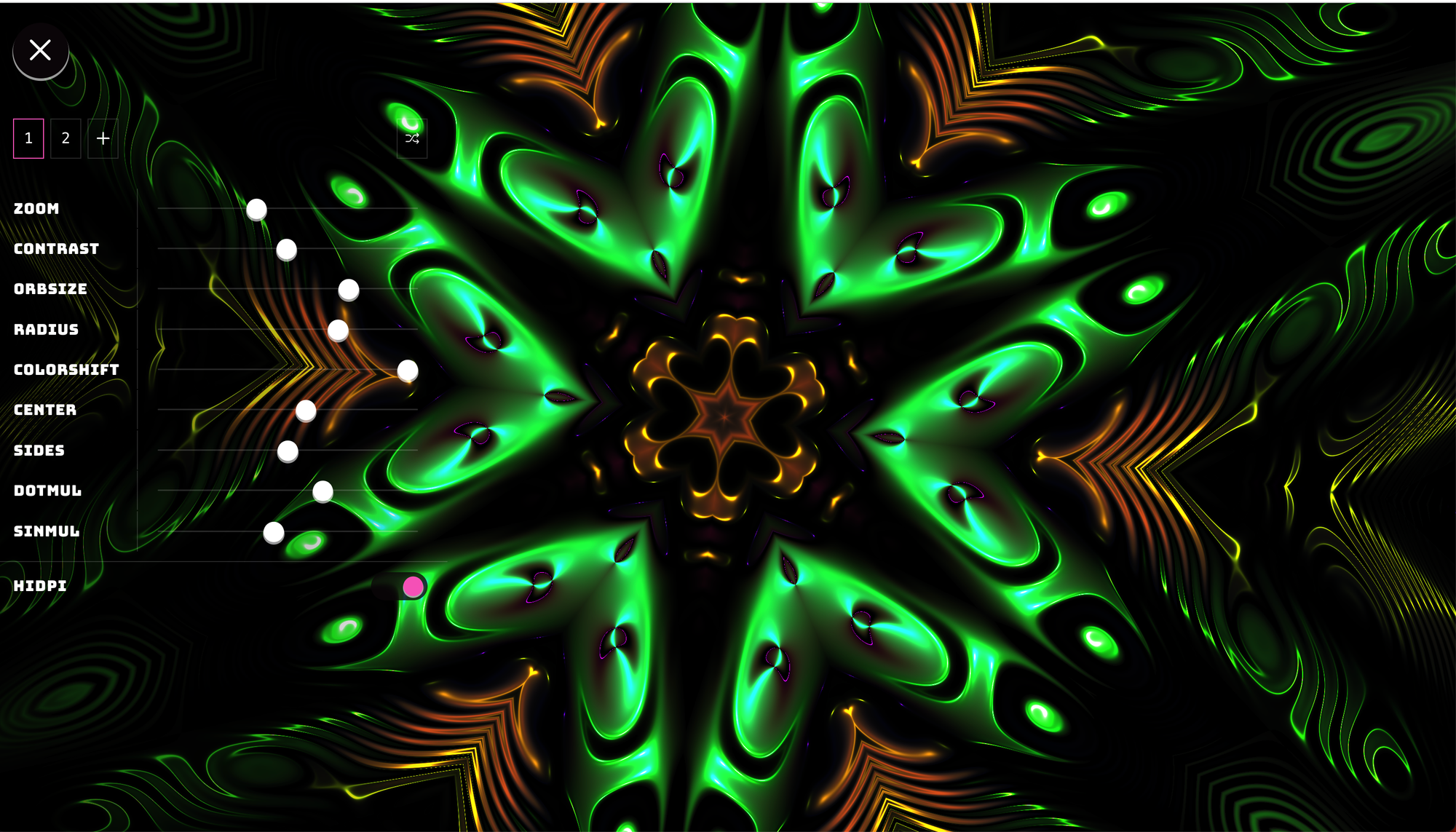
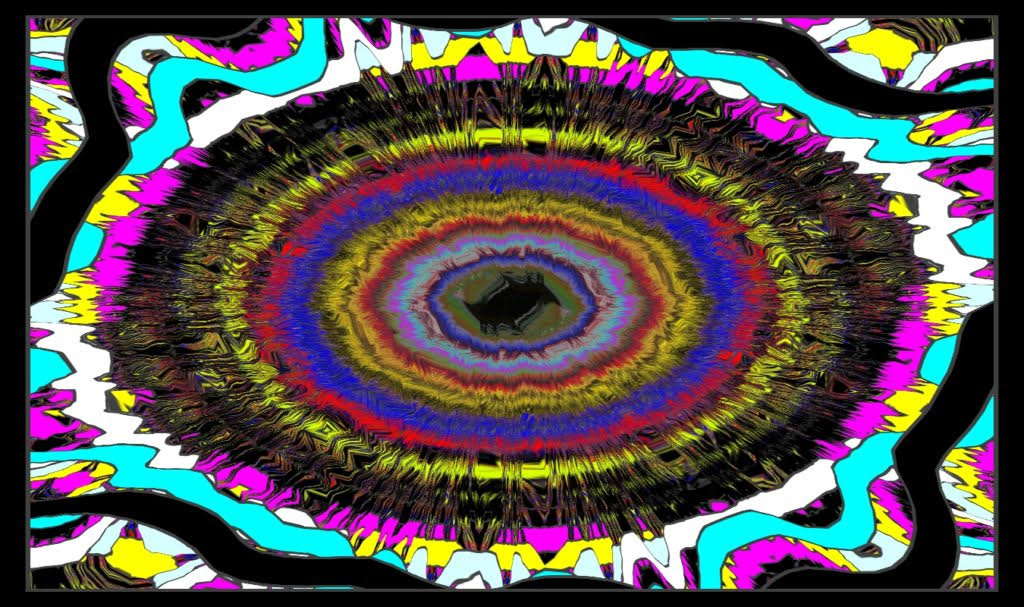
Here are some refernce images
Here are some rough ideas of how I would like the audio visualiser to look. I would like the audio visualiser to contain a lot of blues, purples and whites. This would give it an ethereal feel which I feel like would go with the OST. From what I've seen from other audio visualisers, they tend to have a shape that reacts to the sound. However in this project I personally feel that having the background be reactive would suit better. Since having a nebula-esque background that reacts to the atmospheric sounds would look far better and fit better in the context of the project.
Videos on the Basics of Reactive visuals in Touch Designer
Audio Reactive Visuals (Touch Desinger) <--Audio Reactive Psychedelic visuals (Touch Desinger) <--
Audio Reactive Particles Using Pops! (Touch Desinger) <--